


We don’t make the brands look better; we make them get chosen.
Markets today are saturated with brands that look good and communicate well. Yet many still struggle with a simple problem: they are seen, but not chosen.
The assumption is that better design or more visibility leads to preference. It doesn’t. These only drive awareness, not decisions.
In reality, people don’t evaluate every option. They rely on metal shortcuts, choosing what feels familiar, clear, and easy. What feels like the default gets chosen.
Across multiple brand engagements, a clear pattern emerged. Even strong brands were underperforming, not due to lack of quality, but because they weren’t aligned with how decisions are actually made.
The result is predictable. Well-designed brands continue to underperform, not because they lack quality, but because they are not structured to be chosen.
This led to a shift from building brands that look better to building brands that are easier to choose.
The Fundamental Problem
“Most brands don’t fail because they are poorly designed. They fail because they are not chosen.”
For years, branding has prioritised aesthetics, how a brand looks, how polished it appears, how distinct it feels visually. But visual differentiation alone does not guarantee selection. It only increases visibility.
This creates a flawed competitive space in which brands compete on appearance, assuming that being “better looking” will lead to better outcomes. In reality, this turns branding into a game of chance.
Because choice is not driven by aesthetics alone, it is driven by preference.
And preference is not built through visibility. It is shaped through perception, familiarity, and psychological alignment with how people make decisions.
Until branding shifts from being seen to being chosen, even the most refined brands will continue to struggle where it matters most.
Traditional Approach vs. BehaviourOS
1. Approach
Traditional branding is built visually, focusing on how a brand appears.
BehaviourOS is built behaviourally, focusing on how a brand is chosen.
2. Core Focus
The traditional approach prioritises aesthetics and surface-level differentiation.
BehaviourOS focuses on psychology and decision-making triggers.
3. Output
Traditional branding results in design systems that function as art or decoration.
BehaviourOS creates systems engineered to influence decisions.
4. User Action
Traditional thinking assumes users will evaluate options before choosing.
BehaviourOS recognises that users default rather than evaluate.
5. Goal
Traditional branding aims to make the brand look better.
BehaviourOS aims to make the brand the default choice.
Key Concept: The Shift
1. Aesthetics vs. Psychology
Aesthetics shape first impressions, but they rarely determine final decisions. A visually strong brand may attract attention, but attention alone does not convert into choice. Psychology operates at a deeper level, guiding what feels familiar, trustworthy, and easy to select. This is where real decisions are made.
2. Elevation vs. Default
Traditional branding tries to elevate a brand above competitors through differentiation. However, consumers don’t always compare options in detail. They rely on what feels like the obvious or easiest choice. The shift is from trying to stand out to becoming the default.
3. Design as a System
Design is often treated as a layer of visual enhancement. In reality, it functions as a system that shapes perception and influences behaviour. Every element, visual, verbal, and structural, contributes to how a user decides.
4. Roots, Not Branches
Most branding efforts focus on surface-level changes, such as redesigns or messaging tweaks. These may improve appearance but rarely impact choice. Sustainable results come from addressing the root of how the brand is positioned in the consumer’s mind and what psychological triggers it activates.
The Anatomy of a Decision
To influence choice effectively, branding needs to operate across multiple layers of decision-making. Each layer plays a distinct role, but together, they shape how a brand is perceived and ultimately chosen.
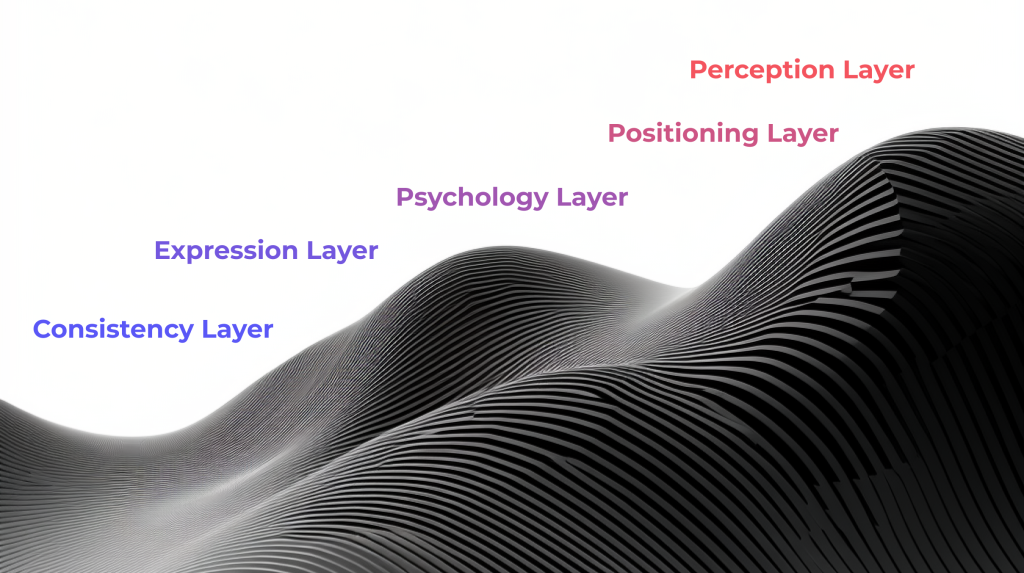
Perception Layer
The first impression is formed within seconds. Users quickly judge whether a brand is worth considering based on immediate visual and contextual cues.
Positioning Layer
How the brand is placed in the consumer’s mind relative to competitors. Clear positioning helps users understand what the brand stands for without confusion.
Psychology Layer (Core)
The most critical layer. This is where trust, desire, and urgency are triggered. It directly influences whether a user chooses the brand.
Expression Layer
The brand’s visual and verbal identity logos, colours, and tone. It communicates the deeper intent but is not the sole driver of decisions.
Consistency Layer
Ensures the brand experience is uniform across all touchpoints. Repetition builds familiarity, and familiarity drives default choice.
Together, these layers move branding from surface-level appeal to a structured system that aligns with how people actually decide.
Psychology Layer (The Engine)
This is where real decisions are made. While other layers shape perception, the psychology layer determines whether a brand is actually chosen.
Human behaviour is not random. It follows patterns driven by triggers such as trust, familiarity, urgency, and perceived value. When these triggers are intentionally designed, outcomes become more predictable.
People don’t move through rigid funnels. They navigate choices, often in non-linear ways. Every interaction, every click, pause, or comparison is a decision point influenced by underlying psychology.
When these triggers are engineered effectively, brands move from being considered to being chosen.
The Three Engineered Defaults
BehaviourOS focuses on creating three key outcomes that directly influence brand success:
Conversion (Engineered Action)
Structuring the brand and its touchpoints in a way that naturally leads users to take action.
Recall (Engineered Memory)
Ensuring the brand stays top-of-mind through consistent and reinforced cues.
Pricing Power (Engineered Value)
Building perceived value that justifies premium positioning without resistance.
Together, these defaults shift the brand from being one of many options to the one that feels like the obvious choice.
What BehaviourOS Actually Is
BehaviourOS is a proprietary system designed to align brands with how people actually think, feel, and make decisions. It moves beyond traditional branding methods by focusing not on how a brand looks, but on how it gets chosen.
It is not a design process. It is a decision-shaping system.
Instead of optimising for visual appeal or surface-level differentiation, BehaviourOS works at the level of human behaviour, structuring perception, positioning, and psychological triggers to influence choice predictably.
The objective is simple but fundamental: not to make brands look better, but to make them easier to choose.
Its application is not limited to a specific category or market. The system has been applied across multiple industries, diverse brand challenges, and varying market conditions, demonstrating that while brands may differ, the way people make decisions remains consistent.
BehaviourOS builds on that consistency, turning it into a strategic advantage.
The Root Change (Not Elevation)
The shift is not about improving what already exists. It is about rethinking the foundation entirely.
Traditional branding focuses on polishing, refining visuals, improving communication, and enhancing presentation. While this may elevate perception, it does not necessarily influence choice.
The new approach focuses on engineering the underlying defaults that drive decisions. Because in reality, consumers do not have the time or energy to evaluate every option. They rely on what feels immediate, familiar, and easy to choose.
When a brand becomes that default, it moves from being an option to being the obvious selection.
Key Principle
Choice is not random. It follows consistent and predictable patterns.
Across industries and categories, while brands may differ, the way people make decisions remains largely the same. These patterns, shaped by psychology, perception, and behaviour, can be identified and engineered.
Recognising this, Leo9 has adopted this approach to move beyond surface-level branding and focus on shaping how choices are made.
By engineering these patterns, branding shifts from guesswork to a more structured and predictable system of influence.
The Bottom Line for BehaviourOS by Leo9
Branding that influences behaviour is the branding that gets chosen.
Branding that does not go unnoticed, no matter how refined it appears.

The difference lies in what the brand is built to do. If it only focuses on aesthetics, it remains surface-level. If it is structured to align with how people think and decide, it becomes a natural choice.
Success, then, is not about being the most visually appealing option. It is about becoming the psychological default.
For brands looking to move beyond visibility and towards consistent preference, this shift is critical. It requires moving from design-led thinking to behaviour-led systems.
This is where Leo9 Studio brings its approach into practice, applying BehaviourOS to help brands not just stand out, but get chosen.
Because in the end, the brands that win are not the ones that look better. They are the ones that are easier to choose.
FAQs on BehaviourOS
It does not treat them as separate objectives. By engineering recall, trust, and perceived value alongside action triggers, BehaviourOS ensures that every interaction contributes to both short-term decisions and long-term preference. Conversion and brand equity are built simultaneously.
The impact goes beyond visual improvement. Brands typically see clearer positioning, stronger recall, and more consistent conversion patterns. Over time, this also enables pricing power, as the brand shifts from being compared to being chosen by default.
Most brand strategies define what a brand should say and how it should look. BehaviourOS goes further by structuring how a brand is chosen. It integrates psychology into every layer, ensuring that positioning, messaging, and design are all aligned with real decision-making patterns, not just communication goals.
While industries differ in context, human decision patterns remain consistent. Trust, familiarity, urgency, and perceived value operate universally. BehaviourOS leverages these constants, then adapts its application based on category dynamics, competition, and audience mindset.