


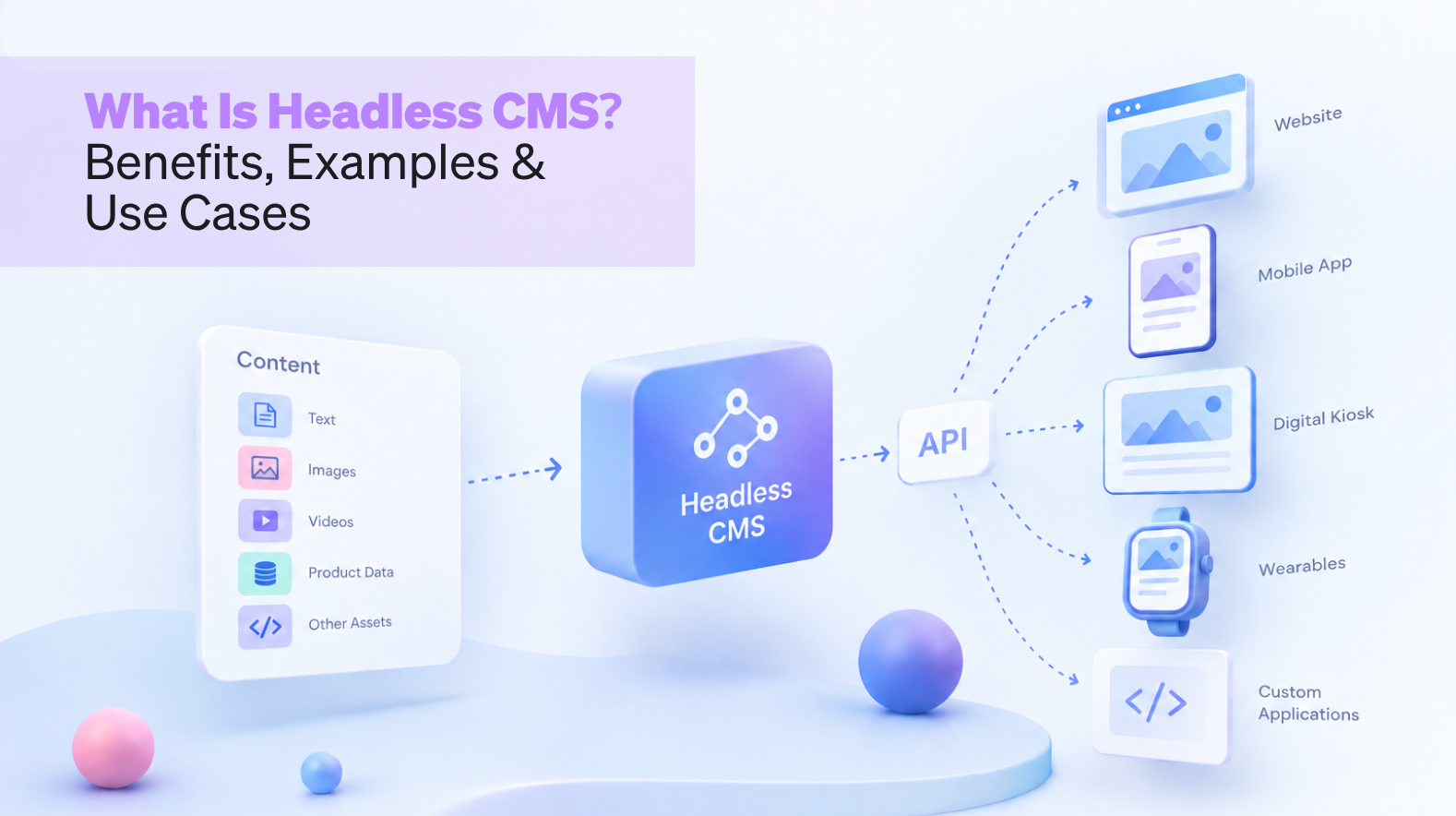
Imagine being able to have content that can function everywhere from mobile apps, or websites to e-commerce sites, smart devices, and any other different kind of experience in the digital space from one source. This is the potential of a headless CMS. Unlike traditional CMS systems, a headless CMS separates the content at the backend from its display at the front end. This means that companies will be able to create and manage content in one location and access it across many digital platforms via their APIs. This allows developers to have more options when dealing with content. Headless CMS solutions have grown immensely popular due to the many advantages they offer.
What Is a Headless CMS?
A headless CMS (Content Management System) is a system that allows for the management of backend content that is separate from any frontend display. The key distinction of headless systems is that they do not dictate the presentation of content to end-users, rather they store and serve content in a format that can be accessed from any digital technological platform by using APIs.
The expression “headless” indicates that one has disabled the head layer of the CMS which was used for the presentation. In a regular CMS model, the content management system is typically linked to the website front. For example, in case a marketer obtains a CMS, both content management and delivery to visitors will be managed by CMS. In contrast, the headless system is more focused on the management and structure of the content.
Headless CMS systems allow for content creation once and delivery to many places and devices at the same time. The same description could be utilized for a web page, mobile application, e-commerce platform, smartwatch, or digital kiosk by means of APIs.

Headless CMS Definition
A Headless CMS refers to a content management system that allows content creation and management on one hand (the back-end) and presenting it on another hand (the front-end). It saves content structure-wise and uses APIs to deliver it. Hence the same content can be accessed on different websites, mobile apps, e-commerce systems, and other digital environments. This means that the headless CMS does not care how the content is shown, which gives developers much freedom and options for their solutions’ personalization and scalability.
How Is a Headless CMS Different From a Traditional CMS?
What Is a Headless CMS?
A headless CMS is defined as a type of content management system that disconnects the backend content management and frontend presentation. By doing that, the businesses can create content, control and manage all operations from one place while serving content through API to other delivery channels such as different mobile applications, websites, e-commerce platforms, and other digital means of delivery. From the development, the front end is independent thus allowing the developers to choose the technology, design as well as UX freely.
What Is a Traditional CMS?
Traditional CMS is categorized as a full option content management system. The traditional CMS is characterized by a close connection between backend part and frontend component. The traditional CMS allows users to produce and distribute content to the site and provide templates, themes, and functionality required for placing content on the website.
The way that headless CMS differs from the traditional CMS is mostly with regard to its architecture as well as the method of delivering content. The architecture of the headless CMS itself is decoupled, meaning that the back end of the platform is not necessarily linked to the front end. The content can be sent via APIs, making it possible to transfer content through any type of digital media such as apps or e-commerce platforms. The developers can experiment with various technologies in their work thanks to the headless CMS as it is very flexible and can be easily adjusted.
The traditional CMS functions in quite the opposite way. The architecture of traditional CMS is coupled and everything happens in one system and may involve more rigid templates. This arrangement creates some challenges because it limits the possibilities of how the content can be presented in the front end.
Overall, the headless CMS seems to have some serious advantages as it allows for creating the next level of interaction with the users as opposed to the traditional CMS.
How Does a Headless CMS Work?
The way a headless Content Management System (CMS) works is that it separates the management of the content from the presentation of that content. The web content is not displayed on any specific website, instead it is stored in an organized way in the CMS and is provided via APIs. Once the content is stored in the CMS, the front end accesses the relevant content in order to decide how to display it to its users.
- Creation and Management of Content
This cycle begins with the creation of content, when the content publishers and marketers create, edit and manage content with the help of headless CMS and are any kind of content including web pages, articles, product information, images, videos and other digital assets. The content will be stored independently from any particular web design.
- Content Is Created and Managed
The content management system has a structured format for storing content. Being independent from one particular layer of presentation, one piece of content can be used in many different experiences without having the need to create it for each of the purposes.
- APIs Connect the CMS to the Front End
The headless CMS gets access through an API which connects it to different applications like the REST and GraphQL API. Then the web application can make requests through the API to the CMS to get the content.
- Content Is Delivered Across Multiple Channels
Once connected, it is possible to deliver the content to a number of places like websites, mobile applications, e-commerce stores, kiosks, smart devices and other digital channels.
Headless CMS vs Traditional CMS
The main difference between a headless CMS and a conventional one can be seen in the way they deal with the content. In a headless CMS, there is a split between the backend and the frontend. The content will be developed in a database that can work through special APIs, like REST and GraphQL, to ensure that the content could be posted on websites or used by mobile apps or even digital screens. Since the frontend is independent from the CMS, developers have the opportunity to apply any technology and framework and build unique user experience.
Conversely, a Traditional CMS utilizes a coupled or monolithic model, wherein the backend is integrated with the frontend within one system. In traditional CMSs, content creation and displaying are regularly accomplished using pre-existing themes, templates, and other components of the CMS. As a result, traditional CMSs are quite easy to employ and manage compared to other types of CMSs and more suitable for companies that need a single website. However, the closeness between content and presentation may make it harder to perform customization or distribution across various platforms.
Another crucial distinction is the amount of reuse content and scalability. Since content can only be created once and distributed through various digital terminals, companies can ensure consistency as well as avoid duplicating the work.
The two approaches also differ in development and maintenance. A headless CMS allows for greater freedom, as its frontend and backend can be developed, maintained, and expanded independently, but that often requires more technical expertise and resources. Typical CMSs tend to provide a simpler configuration and are generally easier to work with for non-technical teams, but modifications depend on the basic structure of the CMS, including themes, plugins, and templates.
In conclusion, one method is not always better than the other. A traditional CMS would be an appropriate solution for firms with simpler tasks, while a headless CMS would suit organizations that need more flexibility, multiple distribution channels, customized experience, and scalability.
Key Features of a Headless CMS
A headless content management system allows for efficiency in utilizing and distributing content by separating its creation from presentation. The features that make the system beneficial are its ability to separate design and management which enhances the utilization of this approach.
- Decoupled Architecture
A headless CMS keeps the content management back end separate from the front end. This allows developers to build and modify the user interface independently without changing how content is stored and managed.
- API-First Content Delivery
Content gets delivered in the form of APIs like REST or GraphQL, which allows for delivery of the content in different applications, platforms, and websites that help the users access its content distributed by means of content management.
- Multi-Channel Content Distribution
Content can be created only once and delivered via multiple websites, applications, devices, and other digital touchpoints allowing organizations to use the same piece of content without the need for additional versions of the content.
- Structured and Reusable Content
By designing content through structured content models, headless CMS solutions are able to use all types of content as separate pieces, whether it is a product description, a picture, an article, or an author profile.
- Scalability
Thanks to the headless architecture, businesses can keep using this technology as their content needs and channels expand. The new platforms can be added to the original content repository through an API integration without requiring redevelopment of the entire CMS.
- Omnichannel Experience
Headless CMS allows businesses to deliver their messages to customers at all points of interaction. The same content can be used for web, mobile, e-commerce, kiosks, smart devices, and many other new platforms, depending on the number of integrations.
Benefits of a Headless CMS for Businesses
A headless content management system delivers added flexibility to organizations regarding content distribution, management, and presentation. Because of the separation of the content management system from its front end, an organization can create content once and utilize it across various platforms while also allowing its development teams to create custom experiences. The value of headless CMS to an organization is reflected in its ability to allow businesses to expand their online presence.
- Enhanced Flexibility
The presence of a headless CMS allows businesses to have more freedom in designing their digital experiences. The developers are free to choose the frameworks, technologies, and designs they deem appropriate for the project as the front end is separated from the CMS.
- Content Delivery via Different Channels
The businesses can process their content from one centralized location and disseminate it via websites, mobile applications, e-commerce systems, digital displays, and others. This minimizes the chances for duplication of content and improves consistency of information across different platforms.
- Enhanced Customization
Companies benefit from a higher degree of freedom in terms of user-facing experiences, as the CMS does not require any specific format for displaying content. This is a significant advantage for companies that wish to provide unique interactive and personalized digital experiences.
- Future-Ready Digital Experiences
A headless CMS helps businesses adapt their content strategy to new technology and platforms. Due to content and presentation being handled separately, new devices and digital channels can access the same content without a complete overhaul of the CMS.
- Potential for Better Performance
Headless architecture enables modern performance improvements like static site generation, server-side rendering, caching, and content delivery networks. However, performance ultimately relies on the front-end, API, hosting, and system design and implementation.
In general, a headless CMS supports companies in creating a responsive, scalable, and multi-channel content ecosystem. Although it may be more challenging than traditional CMS systems, the independence of content from presentation enables organizations to maintain control over their digital experience.
Popular Headless CMS Use Cases
Headless CMS is very advantageous for companies interested in centrally managing content as well as disseminating it across various digital platforms. Such a flexible architecture makes it usable for various business segments and articles like e-commerce businesses, mobile applications, and gadgets.
- E-Commerce Websites
The e-commerce sector utilizes headless CMS extensively to manage product content, blogs, and design content for web pages. Organizations are able to associate this system with their e-commerce applications resulting in instant access to information.
- Corporate and Enterprise Websites
Corporate entities require the management of extensive amounts of company data when operating within an organizational framework. A headless CMS acts as a repository of company data but allows various corporate sites as well as digital sites to use the same content differently.
- Mobile Applications
The use of a headless CMS helps to ensure instant content delivery to mobile applications, Android, and iOS through the use of APIs. Organizations can make necessary changes to the content without updating the application each time a new content update occurs.
- Omnichannel Marketing
Businesses running campaigns over websites, apps, email platforms, social experiences and other digital touchpoints can leverage a headless CMS for ensuring smooth communication across various channels. The content needs to be generated once and can be reused across platforms rather than created again and again.
- Digital Publishing and Media
Headless CMS platforms can help news organizations, publishers and media companies organize their articles, videos, images and authors as well as control their distribution through the company’s website and mobile platforms.
Challenges of Using a Headless CMS
- Higher Development Requirements
A headless CMS does not come with a front-end functionality built into it. To have a finished product, one has to do the development of the front end separately and connect it to the CMS utilizing APIs which means that the developer must possess good technical knowledge and experience.
- More Complex Architecture
Because a headless CMS separates its front end from the back end, it may need a variety of technologies, environments, integrations, and third-party systems which lead to a higher complexity of the system.
- Higher Initial Development Costs
Development of a custom-made front end for a headless CMS costs more both in terms of money and time in the beginning of using a headless CMS. Also, it is important to maintain the successful operation of the headless CMS system.
- SEO Requires Careful Implementation
Having a headless CMS doesn’t help with SEO by itself. In order for the SEO benefits of having a headless CMS to be present, developers need to configure the front end so that it recognizes the metadata, structured data, URLs, rendering, internal linking, site speed, and crawlability properly. Failure to implement the system correctly can lead to impediment in search performance.
- Learning Curve for Content Teams
It may take time for editors used to working with traditional content management systems to adapt to working with structured content and using the more flexible workflow of a headless CMS. The way you edit the content differs depending on a particular headless CMS and its configuration.
- Ongoing Maintenance
Even though the CMS and front end can be updated separately, both of them still require servicing. Companies may have to maintain the performance of APIs, update frameworks and systems they rely on, manage integrations, etc.
In general, the key issue with a headless CMS is managing the trade-off between flexibility and complexity. It can be a good option for companies with multi-channel content needs that have good technical resources, but they need to consider the costs, their ability for development, content processes, and their digital aims before opting for a headless CMS.
Is a Headless CMS Right for Your Business?
The decision regarding whether to use a headless CMS or a standard CMS will be based on your business objectives, content needs, online presence, and technological skills. Headless CMS systems could be advantageous for companies that require an adaptable system that can provide content to many platforms but are not something every business needs to adopt.
The headless CMS option should be considered by businesses that provide content for different websites, mobile applications, or e-commerce platforms, work with different brands, and want to have complete control over their websites. Select this option if you are going to utilize more online platforms, want to make sure developers work with modern systems and technologies, or plan to maximize content reuse across different entities as you grow.
In contrast, traditional CMS systems are likely to be ideal solutions for small companies or those sites that do not have complex content demands. If all that you require is just one site, you can manage your entire project without doing a single line of code because you will rely on standard templates, then using a headless CMS might not be worth it for you.
In summary, there is no universal answer to this question. Each company needs to analyze its content strategy, budget, available development resources, number of channels, scaling, and objectives to choose the proper solution.
How to Choose the Right Headless CMS
The selection of a good headless CMS depends upon the needs of your organization and your overall content strategy, technical skillset, and future growth outlook. Since there are many providers in the market, each with its own set of features, pricing schemes, APIs, and integration methods, one must be careful when selecting the solution for oneself.
- Define Your Content Requirements
Determine the various types of content you need to make use of. Do you need to work with articles, product descriptions, images and videos, landing pages, or structured data? And how many users will be collaborating on it?
- Check API and Integration Support
APIs are at the core of a headless CMS. Look for platforms that provide reliable REST or GraphQL APIs and integrate easily with the tools your business already uses, such as e-commerce platforms, CRM systems, analytics tools, and marketing platforms.
- Evaluate Developer Experience
Think about the technology stack being used by the development team you collaborate with. The CMS must be capable of easily cooperating with the frameworks being widely used by developers and include comprehensive documentation, SDKs, developer tools, and testing spaces.
- Consider Scalability
Make sure to select a CMS that offers you enough capability to expand whenever your business grows and the content and channels multiply. Check the factors like the amount of content, API utilization, support of multiple websites, localization possibilities, visitor traffic, and possible need of other digital platforms.
- Look at the Content Editor Experience
While it is essential to have technical flexibility, it is also important to keep the CMS user-friendly for marketers and content creators. Look for such options as visual previews, workflows, a scheduling feature, version history, access controls, and collaborative editing.
- Review Security and Reliability
Security is one of the most important factors when choosing software for enterprise websites and applications. Review all possible authentication methods, data protection measures, access control, uptime, and security procedures before making a decision.
- Consider Omnichannel Capabilities
If your company intends to send out content over multiple channels to consumers like websites, mobile applications, e-commerce platforms, kiosks, or any new platforms for media delivery, you must choose a CMS that can support multiple interfaces and ways of delivering content efficiently.
- Assess Vendor Support and Ecosystem
Proper documentation and customer support can significantly ease the implementation process. Check the platform’s community, software integrations, provider partners, technical support, and future product roadmap.
In the end, the ideal headless CMS should be a compromise between flexibility for developers, ease of content management, scalability, security, connectivity, and pricing. The best service does not necessarily mean that it has the most functionalities; it is the solution that meets your current needs.
Frequently Asked Questions About Headless CMS
A headless CMS is a content management system that separates content management from the way content is displayed. Content is stored in one place and delivered through APIs to websites, mobile apps, e-commerce platforms, and other digital channels.
A traditional CMS combines the back end and front end, meaning it manages both content and how that content is displayed. A headless CMS separates these layers, giving developers greater flexibility to choose how and where content is presented.
Key benefits include greater flexibility, multi-channel content delivery, scalability, easier content reuse, front-end freedom, and integration capabilities. It allows businesses to manage content centrally while creating customized experiences across different platforms.
Yes. A headless CMS can be particularly useful for e-commerce businesses that need to manage product content, campaigns, landing pages, editorial content, and brand experiences across websites, mobile apps, and other shopping channels.
A headless CMS can be a strong option for large businesses that manage multiple websites, brands, regions, or digital platforms. Its centralized content management and scalable architecture can make it easier to maintain consistent content across complex digital ecosystems. However, smaller businesses can also benefit if they have the technical resources and multi-channel requirements to justify it.
The CMS itself can usually be managed by non-technical users for tasks such as creating and editing content. However, coding and development expertise are generally required to build the front end, connect APIs, create integrations, and customize the overall digital experience.
A business should consider a headless CMS when it needs to deliver content across multiple digital channels, build highly customized experiences, support modern front-end technologies, or scale its digital presence over time. For a simple website with limited content and a small development team, a traditional CMS may be a more practical option.