

“People don’t remember brands that try to impress. They remember brands that make them feel something.”
Most brands play it safe. They try to be liked, polished, and easy to accept.
But the ones people actually remember? They challenge things. They take a stand.
That’s where the Outlaw archetype comes in.
In a world full of sameness, the Outlaw breaks patterns. It questions rules, calls out the status quo, and connects with people who already feel that tension but rarely see it reflected in brands.
This is why it still works.
Today’s audience isn’t looking for perfect brands. They’re drawn to brands that feel real, bold, and unapologetic about what they stand against.
The Outlaw doesn’t speak to everyone. It speaks to the ones who are ready to see things differently.
What Is the Outlaw Archetype in Branding?
The Outlaw archetype is built on one simple idea: break what doesn’t work and rebuild it better.
It’s the brand that questions rules instead of following them. It pushes against authority, challenges outdated systems, and refuses to blend in just to stay accepted.
But this isn’t rebellion for attention.
A true Outlaw brand stands for liberation. It exists to give people a sense of freedom, whether that’s freedom of choice, identity, or thinking. It speaks to those who feel restricted by norms and are looking for something that reflects their mindset. That’s what separates it from surface-level “edgy” branding. The Outlaw doesn’t just look different. It believes something different.
It also always has a clear enemy. Usually, that’s the status quo. The “this is how it’s always been done” thinking. Without that tension, the archetype falls flat. In branding terms, the Outlaw isn’t trying to fit into a category. It’s trying to redefine it.
Core Traits of the Outlaw Brand Archetype
Outlaw brands are easy to recognise. They don’t soften their edges.
They’re rebellious and openly challenge authority. Independent to the point where they reject the need to fit in. And bold enough to say what others avoid.
There’s also a deliberate sense of controversy. Not to shock, but to provoke thought and push boundaries.
At their core, they’re driven by defiance and conviction. They stand for something, and they’re not afraid to show it.
But here’s the nuance behind the aggression: there’s usually a clear intent.
Brand Voice & Messaging: How Outlaw Brands Speak
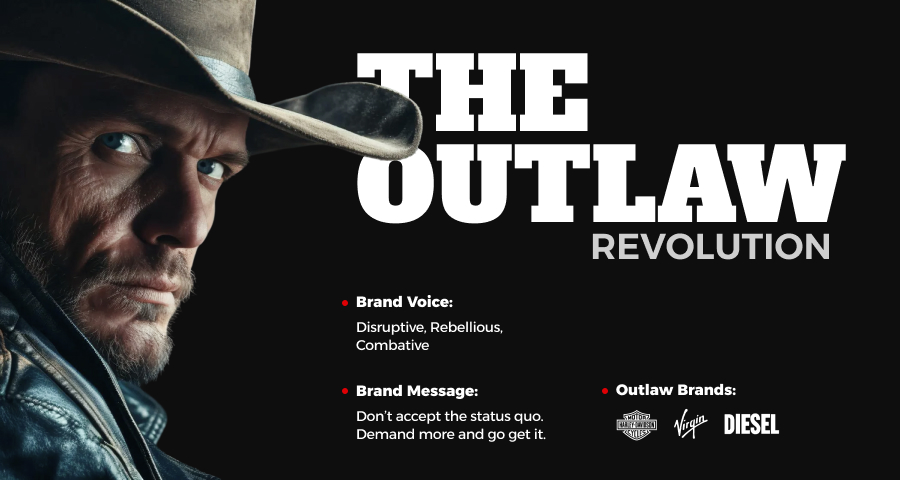
Outlaw brands don’t sound polished. They sound certain. The tone is direct, bold, and unapologetic. No fluff, no corporate language, no trying to please everyone. They say what they mean, and they say it clearly.
There’s often an edge of defiance in the messaging. It calls things out. Questions norms. Sometimes, it even challenges the audience to think differently. But it’s not random aggression.
Good Outlaw messaging feels like it’s coming from the same place as the audience. It reflects what they already feel but haven’t heard brands say out loud.
That’s why it works.
It doesn’t talk to people. It speaks like it’s on their side.
They’re not breaking things for the sake of chaos. They’re doing it to create change.
Visual Identity & Brand Expression of the Outlaw Archetype
Bold by Design, Not by Chance
Outlaw brands don’t aim to blend in. Their visual identity is built to stand out instantly and make a statement.
Colour Palette
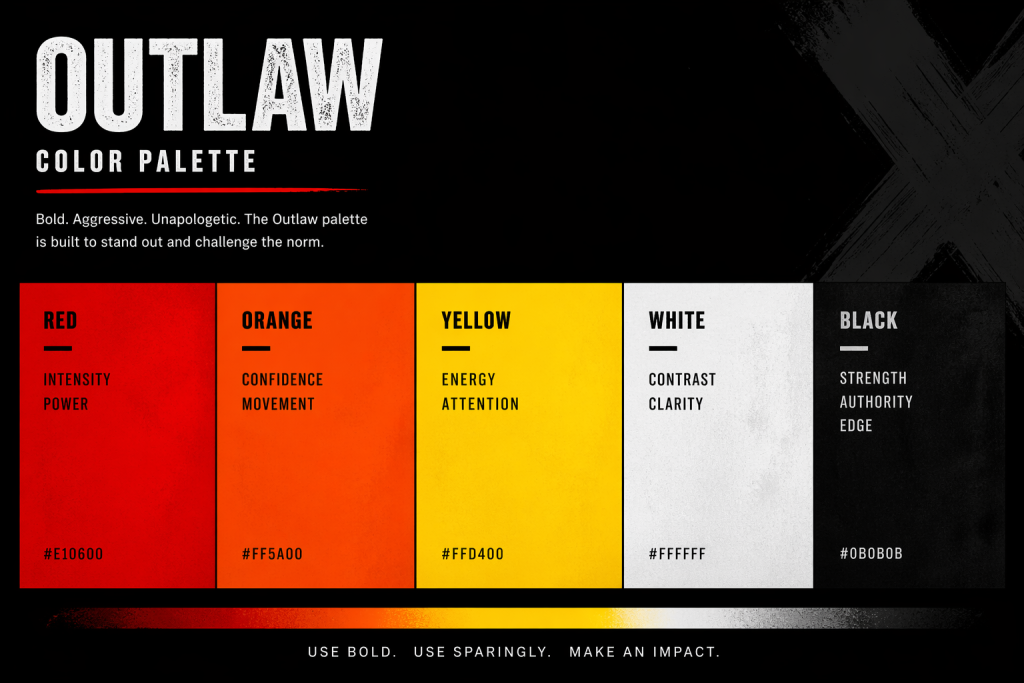
The palette is loud and intentional. Red brings intensity and power. Orange adds confidence and movement. Yellow introduces sharp, high-energy contrast. These colours are chosen to grab attention, not to soothe.
Typography
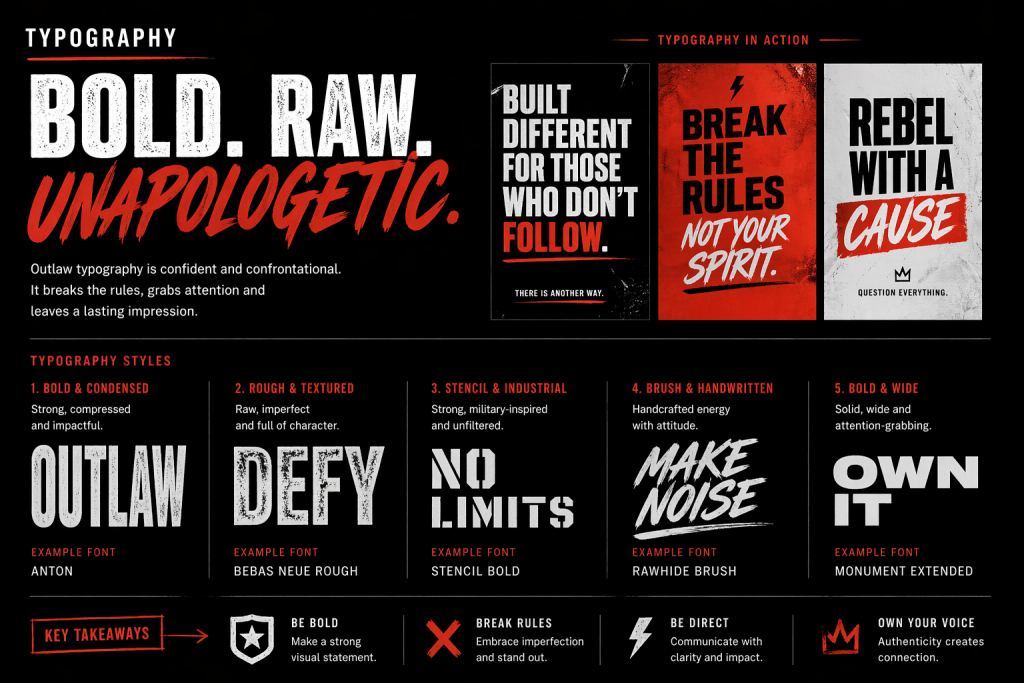
Fonts are strong, heavy, and often a little rough around the edges. Clean perfection is avoided. The goal is to feel real, raw, and impossible to ignore.
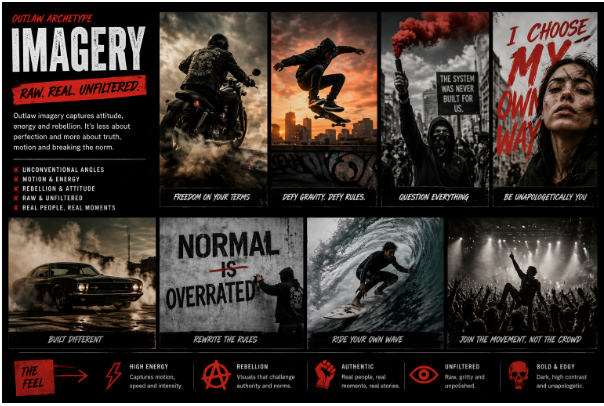
Imagery
Visuals focus on action and attitude. You’ll see movement, rebellion, and unconventional moments. It’s less about polished perfection and more about capturing energy and edge.
Design Style
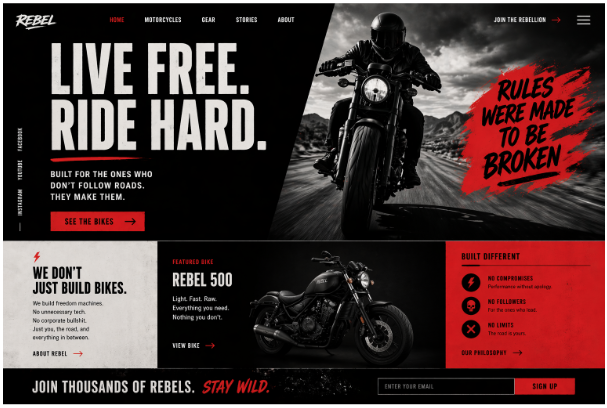
The approach is stripped back but impactful. High contrast, bold layouts, and visuals that communicate fast. No extra elements, no over-design.
Overall Expression
Everything in the visual system should feel like it’s pushing against norms, not following them.
Industries Where the Outlaw Archetype Performs Best
The Outlaw works best in industries where challenging the norm actually makes sense. If there’s nothing to disrupt, the archetype feels forced.
You’ll see it strongly in automotive and lifestyle brands.
Take Harley-Davidson. It doesn’t just sell bikes. It sells freedom, rebellion, and a culture built around breaking away from routine life.
It also thrives in youth and entertainment spaces.
MTV built its identity by pushing boundaries and rejecting traditional media norms. Similarly, Mountain Dew leans into extreme sports and anti-mainstream energy.
Another strong space is technology and finance disruptors.
PayPal positioned itself as an alternative to traditional banking systems. Bitcoin goes even further by challenging the idea of centralised financial control altogether.
You’ll also find it in challenger brands across industries.
Virgin Group has consistently entered established markets by doing things differently and questioning industry norms.
The pattern is clear. The Outlaw performs best where there’s an existing system people are frustrated with and a brand willing to openly challenge it.
How Leo9 Studio Applies the Outlaw Archetype in Brand Strategy
At Leo9 Studio, the Outlaw archetype is approached as a strategic stance, not just a style.
It starts with identifying what the brand is pushing against, whether it’s category norms, predictable messaging, or outdated experiences. Without that, there’s no real differentiation.
From there, the focus is on building a clear point of view across messaging, design, and digital touchpoints.
The idea isn’t to be loud for attention. It’s to create work that feels intentional, distinct, and aligned with what the audience already believes.
Because real disruption isn’t about looking different. It’s about standing for something people connect with.
Conclusion: The Outlaw Archetype Is About Freedom, Not Chaos
The Outlaw isn’t about being loud for the sake of it. It’s about standing for something that challenges the norm.
When done right, it builds a strong emotional connection with people who already feel that resistance. It gives them a voice, a perspective, and a brand they can actually relate to.
But it only works when it’s real.
Without a clear purpose, it turns into noise. Without conviction, it feels forced. And without a meaningful alternative, it doesn’t last.
The Outlaw isn’t here to break everything.
It’s here to break what no longer works and create something better.
If your brand is ready to challenge the expected and build something that truly stands apart, Leo9 Studio can help you shape that direction with clarity and intent.
FAQs
Losing freedom and becoming part of the system it once challenged. The fear is blending into conformity or being controlled.
Being rebellious without purpose, overusing shock value, and coming across as chaotic or irresponsible. Lack of authenticity is the biggest risk.
They take a bold, direct approach. Messaging is unapologetic, challenges norms, and speaks to a like-minded audience rather than trying to appeal to everyone.
Liberation. The freedom to break rules, challenge systems, and create a new way forward.