


Discover how AI is transforming design agencies in the UAE for 2026. Learn the tools, models, and governance agencies need to win.
2026 the phrase AI Is Transforming Design Agencies in the UAE has moved from marketing headline to operational reality, shaping how creative teams ideate, produce, and personalise By design work at scale. Across the Emirates, AI-powered creative systems, agentic workflows, and embedded automation are no longer “nice-to-have” experiments; they are central to how agencies deliver faster, smarter, and more personalized creative work for clients in sectors like tourism, hospitality, finance, and government. According to DesignRush News, this shift aligns with broader market dynamics: generative AI adoption has surged globally with 71% of organizations now using generative AI, yielding an average ROI of about $3.70 for every $1 invested in creative applications according to industry analysis.
In the UAE specifically, the digital environment is exceptionally fertile for this transformation. The country boasts one of the highest AI adoption rates worldwide, with over 97% of residents using AI tools or services in daily life, reflecting a mature digital infrastructure and strong consumer comfort with intelligent systems.According to LinkedIn, local research also highlights that nearly 60% of enterprises leverage AI technologies to enhance customer experience and operational efficiency, and the UAE’s generative AI market is rapidly expanding as a result.
Consequently, AI is transforming Design Agencies in the UAE by enabling rapid ideation through sophisticated generative models, automating repetitive production tasks, and powering personalised creative experiences tailored to diverse audiences. These innovations are not only boosting productivity but also reshaping service offerings, pushing agencies to retool business models to compete in an AI-driven economy where speed, scale, and strategic integration of intelligent systems are essential for success.
Why is the UAE Fertile Ground for Creative-AI Adoption?
The rapid acceleration of AI adoption in the Emirates is no coincidence. In 2026, AI Is Transforming Design Agencies in the UAE not just because of technological availability, but due to a unique convergence of market ambition, client expectations, and digital maturity. Few regions globally provide such a fertile environment for creative-AI innovation at scale.
1.A Market That Demands Speed, Scale, and Sophistication
The UAE is a high-velocity market where brands compete in real time for attention across digital, physical, and experiential touchpoints. Tourism, real estate, luxury retail, fintech, and government initiatives operate on compressed timelines and global visibility. For design agencies, this means delivering high-quality creative outputs faster than ever before.
AI enables agencies to ideate, prototype, and deploy creative assets at a pace that traditional workflows cannot match. From rapid brand concept exploration to multi-format campaign rollouts, AI is transforming Design Agencies in the UAE by allowing them to meet aggressive deadlines without compromising creative ambition.
2.Digitally Mature Clients with Enterprise-Level Expectations
UAE-based clients are among the most digitally mature in the region. Large organizations already leverage AI across operations from analytics to customer experience — and expect their design partners to operate at the same level of sophistication.
This maturity creates a natural demand for AI-enabled design services such as personalization at scale, dynamic content systems, and data-driven UX optimization. As a result, AI is transforming Design Agencies in the UAE into strategic partners who contribute to measurable business outcomes, not just visual execution.
3.Government-Led Innovation and AI-First Vision
The UAE’s strong governmental push toward AI adoption plays a crucial role in accelerating creative-AI usage. National AI strategies, smart city initiatives, and public-sector digital transformation projects normalize AI as a trusted and regulated technology rather than an experimental risk.
This top-down endorsement gives agencies confidence to invest in AI tooling, training, and infrastructure. When public institutions embrace AI-powered design and digital experiences, it sends a clear market signal that AI is transforming Design Agencies in the UAE in a sustainable, long-term way.
4.A Multicultural Audience That Demands Intelligent Personalization
Few markets are as culturally diverse as the UAE. Brands must communicate across languages, cultural contexts, and global sensibilities often simultaneously. AI-driven creative systems make it possible to localize visuals, copy, and experiences at scale without fragmenting brand identity.
For design agencies, this complexity is an opportunity. By leveraging AI for intelligent localization and personalization, AI Is Transforming Design Agencies in the UAE into specialists in adaptive, culturally nuanced design a competitive advantage that is difficult to replicate elsewhere.
What are the Tools Powering the Change?
The reason AI is transforming Design Agencies in the UAE so rapidly in 2026 is not theory or hype, it is the maturity of the tools now embedded directly into creative, strategic and production workflows. Unlike earlier generations of AI, today’s systems are purpose-built for designers, strategists and marketers, allowing agencies to move faster without compromising brand quality or cultural relevance.
1.Generative visual and motion tools
Generative image and video platforms have become foundational across UAE design agencies. Tools such as Adobe Firefly, Runway, and enterprise-grade image generators enable teams to create high-fidelity concept art, brand visuals, and motion assets in minutes. Designers no longer start with a blank canvas; instead, they curate, refine and direct AI outputs, accelerating ideation while maintaining creative intent. This shift is one of the most visible ways AI is transforming Design Agencies in the UAE, especially in high-volume sectors like real estate, hospitality and tourism marketing.
2.AI-augmented design platforms
Modern design environments now embed AI directly into their interfaces. Platforms like Figma AI and Adobe’s generative layout tools assist with auto-layout creation, responsive design adjustments, copy suggestions and component generation. These tools reduce manual execution time and allow designers to focus on hierarchy, storytelling and experience logic. In practice, AI functions as a junior designer fast, tireless, and guided by human oversight enabling agencies to scale output without scaling headcount linearly.
3.Conversational creative assistants
One of the most impactful developments in 2025-26 is the rise of conversational creative assistants. Designers and strategists can now request visual variations, copy rewrites, accessibility fixes or localization changes using natural language prompts. With creative tools increasingly integrated into chat-based environments, revisions that once required multiple handoffs now happen instantly. This conversational layer has reshaped internal collaboration and client feedback loops, further reinforcing how AI is transforming Design Agencies in the UAE at an operational level.
4.Automation and workflow orchestration
Beyond ideation and design, AI powers automation across the entire production pipeline. Agencies use AI-driven systems to resize assets for multiple platforms, generate multilingual versions, populate CMS fields, and prepare campaign-ready deliverables. Workflow orchestration tools ensure consistency across channels while reducing human error, making large-scale campaigns manageable even with lean teams.
5.Analytics, testing and personalization engines
Finally, AI tools increasingly guide what gets designed, not just how. Machine learning-driven analytics platforms analyze user behavior, test creative variants, and predict performance outcomes. This allows agencies to tie design decisions directly to data, ensuring creativity is not only beautiful but commercially effective.
Together, these tools form the technological backbone of the modern agency, proving that AI is not replacing designers, it is redefining how design excellence is achieved.
Measuring success:Metrics that matter
Track both creative and business KPIs:
- Creative velocity: assets produced per week, iteration cycles shortened.
- Efficiency: billable hours saved, cost per asset.
- Performance lifts: engagement, CTR and conversion for personalized creatives.
- Quality & compliance: % of assets passing brand QA without rework.
- Revenue upside: new recurring revenue from AI-powered services.
McKinsey’s research reinforces that enterprises that combine metrics with disciplined processes extract far more value from AI investments.
Changes AI Is Bringing in Design Agencies in the UAE

The conversation around how AI Is Transforming Design Agencies in the UAE has shifted rapidly from experimentation to execution. What once felt like optional innovation has become a structural change in how agencies think, work, price, and deliver value. Across Dubai, Abu Dhabi, and other innovation-driven hubs, AI is reshaping the creative industry at multiple levels—operational, strategic, and cultural.
1.From manual creation to AI-accelerated ideation
One of the most visible changes is the way ideas are generated. Creative ideation, which previously relied heavily on manual brainstorming and long concept cycles, is now augmented by generative AI tools. Designers can instantly explore multiple visual directions, brand narratives, or layout systems, allowing teams to evaluate more options before committing to a final direction. This shift is a clear example of how AI Is Transforming Design Agencies in the UAE by increasing creative breadth without increasing timelines.
Rather than replacing creativity, AI acts as a multiplier helping designers start from stronger foundations and focus their energy on refinement, storytelling, and strategic alignment.
2.Faster production, leaner teams, smarter workflows
Another major change lies in production efficiency. AI tools now automate time-consuming tasks such as image resizing, asset versioning, background removal, typography suggestions, and even initial copy drafts. As a result, agencies are delivering complex multi-channel campaigns in significantly shorter timeframes.
This efficiency is not just about speed; it’s about scalability. With AI integrated into design pipelines, agencies can handle larger workloads without proportionally expanding team sizes. This operational shift underscores why AI Is Transforming Design Agencies in the UAE at a business-model level, not just a creative one.
3.Personalization at a level previously impossible
In the UAE’s diverse, multicultural market, personalization has always been a challenge. AI is changing that. Design agencies are now able to produce dynamic creative systems that adapt visuals, language, tone, and layouts based on audience segments, geographies, or user behaviour.
For sectors such as hospitality, tourism, real estate, and fintech, this means delivering culturally relevant experiences at scale. This level of adaptive design was previously expensive and slow, but today it is becoming standard practice—further reinforcing how AI Is Transforming Design Agencies in the UAE through smarter, data-informed creativity.
4.New creative roles and evolving skill sets
As AI becomes embedded in design processes, the nature of creative roles is evolving. Traditional execution-heavy roles are giving way to hybrid positions such as AI design producers, prompt specialists, and creative technologists. Senior designers are increasingly expected to act as curators evaluating, refining, and contextualizing AI-generated outputs rather than creating everything from scratch.
This evolution highlights another dimension of how AI Is Transforming Design Agencies in the UAE: talent strategy. Agencies are investing more in upskilling their teams, combining design thinking with AI literacy to remain competitive in a rapidly changing market.
5.Strategic design backed by data, not assumptions
AI is also influencing how agencies make decisions. Predictive analytics, sentiment analysis, and AI-driven research tools allow design teams to test concepts, assess market reactions, and refine messaging before campaigns go live. Creative strategy is becoming more evidence-based, reducing subjective guesswork.
This data-informed approach is particularly valuable in the UAE’s high-stakes, premium markets, where brands expect measurable outcomes from design investments. It’s yet another reason why AI Is Transforming Design Agencies in the UAE into strategic partners rather than execution vendors.
6.Governance, ethics, and quality control become essential
With increased AI usage comes increased responsibility. Agencies are now developing governance frameworks around AI usage covering intellectual property, brand consistency, cultural sensitivity, and ethical design practices. Human oversight remains central, ensuring that AI-generated work aligns with brand values and regional expectations.
This balance between automation and accountability defines the mature stage of adoption and reflects how AI Is Transforming Design Agencies in the UAE responsibly, not recklessly.
7.A fundamental shift, not a passing trend
Ultimately, the changes AI brings are not incremental; they are foundational. Agencies that treat AI as a core capability are redesigning their workflows, services, and value propositions. Those that don’t risk falling behind in a market that prizes innovation, speed, and precision.
The future of design in the UAE belongs to agencies that can blend human creativity with machine intelligence seamlessly. And that future is already here.
How is AI Changing the Design Agencies in the UAE
- From manual creation to AI-accelerated ideation
- Faster production, leaner teams, smarter workflows
- Personalization at a level previously impossible
- New creative roles and evolving skill sets
- Strategic design backed by data, not assumptions
- Governance, ethics, and quality control become essential
- A fundamental shift, not a passing trend
Spotlight: ASAS Capital – AI-Driven Premium UX
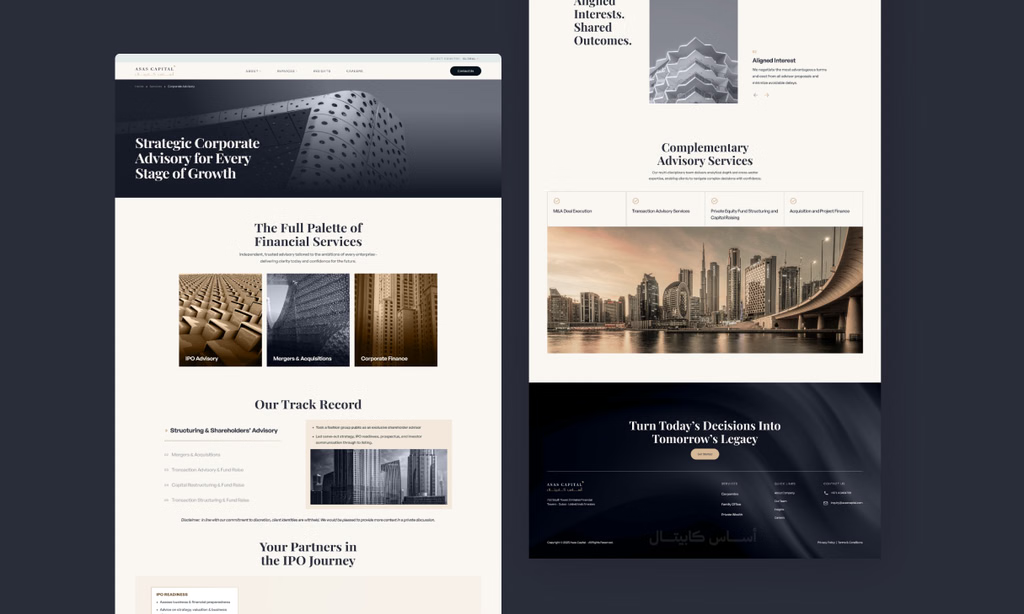
The transformation of ASAS Capital’s digital presence offers a compelling real-world example of how AI is transforming Design Agencies in the UAE and the calibre of work expected in ultra-premium financial markets. Serving ultra-high-net-worth individuals across global markets, ASAS Capital required a digital experience that conveyed authority, discretion, and enduring trust without relying on overt visual excess.
Leo9 partnered with ASAS Capital to reimagine its website as a refined digital flagship that reflects the firm’s positioning as a DFSA-regulated asset management institution catering to an elite clientele.
The Challenge
ASAS Capital operates in a highly sensitive, trust-driven domain where perception is as critical as performance. The existing website lacked the visual gravitas, emotional restraint, and experiential depth expected by sophisticated investors. While functional, it failed to communicate the firm’s exclusivity, stability, and long-term credibility.
Traditional design approaches alone were insufficient. The challenge was to craft a high-end fintech experience that felt timeless rather than trendy, confident rather than loud while subtly integrating advanced technology to elevate user perception. This required a design approach where AI supported aesthetic precision rather than dominating the experience.
The Leo9 Solution: AI-Driven Aesthetic Engineering
Leo9 approached the redesign through what can best be described as AI-driven aesthetic engineering using artificial intelligence as an invisible enabler of luxury, clarity, and performance.
Cinematic First Fold
The homepage opens with a cinematic first fold powered by AI-generated video elements. Rather than being promotional, the motion design creates an atmospheric introduction evoking scale, confidence, and composure. The result is an immediate emotional signal of premium positioning without overwhelming the user.
Subtle Regional Intelligence
AI-assisted design exploration allowed Leo9 to study and integrate nuanced regional cues inspired by the GCC market. These influences appear through restrained typography, spatial hierarchy, and tonal balance ensuring cultural relevance while avoiding visual clichés commonly seen in regional fintech websites.
Precision-Optimized User Experience
Every interaction was deliberately refined. AI-supported UX analysis helped eliminate friction across navigation, transitions, and content discovery. For ultra-wealthy users who value discretion and efficiency, the experience feels seamless, calm, and intuitive designed to respect both time and attention.
Throughout the process, AI functioned as a tool for enhancement rather than spectacle, reinforcing the idea that AI Is Transforming Design Agencies in the UAE by enabling deeper refinement, not just faster output.
The Impact
The redesigned ASAS Capital website is more than a visual upgrade it is a strategic brand asset. The platform now operates as a conversion-ready, credibility-driven digital presence aligned with the expectations of elite investors.
The impact is visible across three key dimensions:
- A visually restrained yet unmistakably premium user experience that communicates trust and exclusivity
- Improved usability and interaction flow, tailored to the behaviour patterns of high-net-worth users
- A clear demonstration of how AI-enabled design can elevate brand perception in regulated, high-stakes financial environments
By blending advanced AI capabilities with disciplined UX and visual restraint, Leo9 delivered a digital experience that feels authoritative, elegant, and future-ready setting a benchmark for premium fintech design in the region.
5 Tips to Choose an AI-Driven Design Agency in the UAE
Choosing the right AI-driven design agency is no longer just about aesthetics—it’s about strategic capability, governance, and measurable outcomes. Use the following criteria to evaluate potential partners in the UAE market.
1. Look beyond tools ask about process
Any agency can claim to use AI tools. What matters is how those tools are embedded into their design process. Ask how AI supports research, ideation, UX optimisation, and personalization—and where human judgment takes over. Mature agencies use AI to enhance decision-making, not replace it.
2. Demand proof of real-world impact
An AI-driven agency should be able to demonstrate outcomes, not just concepts. Look for case studies that show faster delivery, improved engagement, higher conversions, or operational efficiency. Results matter more than experimental visuals.
3. Evaluate governance and IP responsibility
AI introduces questions around intellectual property, data security, and brand safety. A credible agency will have clear policies on AI usage, content ownership, cultural review, and human validation especially critical in regulated or premium industries.
4. Assess regional and cultural intelligence
The UAE is a culturally diverse and highly nuanced market. Ensure the agency understands regional expectations and can localize AI-generated design without falling into stereotypes. Cultural sensitivity should be designed in, not added later.
5. Choose a partner, not just a vendor
The strongest AI-driven agencies act as long-term partners. They help you scale design systems, evolve digital platforms, and adapt as AI capabilities mature—rather than delivering one-off projects with short-term impact.
Conclusion
As 2026 unfolds, AI Is Transforming Design Agencies in the UAE not as a passing trend, but as a structural shift redefining how creativity, technology, and business strategy intersect. From rapid ideation and intelligent personalization to governance-led workflows and measurable outcomes, AI Is Transforming Design Agencies in the UAE by elevating both creative quality and operational maturity. What separates leaders from followers is not tool adoption alone, but the ability to blend human insight with intelligent systems responsibly proving once again that AI Is Transforming Design Agencies in the UAE at the level of process, culture, and long-term value creation.
For brands navigating this evolution, partnering with teams who understand why AI Is Transforming Design Agencies in the UAE and how to apply it with precision can define sustained digital success. If you’re exploring how AI can elevate your digital experience while preserving craft, credibility, and control, a strategic conversation with Leo9 Studio is a strong place to begin. Connect Today!
FAQ’s
AI Is Transforming Design Agencies in the UAE by accelerating ideation, automating production workflows, and enabling personalized digital experiences at scale. Agencies now use AI to support UX research, design systems, content localization, and performance optimization allowing faster delivery without compromising brand quality or cultural relevance.
Modern agencies offer AI-enabled UX/UI design, intelligent branding systems, personalized web experiences, automation-driven content production, and AI-supported research and testing. Leading studios combine these capabilities with strong governance and human oversight to ensure consistent, premium outcomes.
No. While AI Is Transforming Design Agencies in the UAE, it is augmenting designers rather than replacing them. AI handles repetitive and data-heavy tasks, allowing designers to focus on strategy, storytelling, and experience design. The most successful agencies treat AI as a creative accelerator, not a substitute for human judgment.
Premium brands gain faster go-to-market execution, deeper personalization, and more consistent brand experiences across channels. When implemented thoughtfully, AI helps elevate perceived brand value especially in sectors like fintech, luxury, hospitality, and enterprise technology.
Brands should evaluate process maturity, governance frameworks, cultural intelligence, and proven outcomes, not just AI tools. Agencies with experience blending AI with disciplined UX strategy and premium design execution tend to deliver more sustainable results.
Leo9 Studio approaches AI as an enabler of design excellence, not a shortcut. By integrating AI into research, ideation, UX optimization, and production while maintaining strong human oversight Leo9 delivers intelligent, scalable, and brand-safe digital experiences tailored to high-stakes markets.